
Home / Repair guides / Refrigerator not cooling
REPAIR GUIDE
Refrigerator Not Cooling? Here Is What to Check
When the fridge is warm, the clock is ticking on your food. This guide covers the common causes, the quick checks that are safe to do yourself and how to protect what is inside.
Protect your food first
This follows standard USDA food safety guidance.
- Keep the doors closed as much as possible
- Food is safe in a closed fridge for about 4 hours without power
- Move perishable items to a cooler with ice if the fridge stays warm
- Use a thermometer: the fridge should be at 40°F or below, the freezer at 0°F
- Throw out perishable food that has been above 40°F for more than two hours
- When in doubt, throw it out
Our urgent guide has a full step-by-step for the first hours.
Five quick checks
Check the power
Make sure the fridge is plugged in, the outlet works and the breaker has not tripped.
Check the temperature settings
A dial or panel setting may have been bumped. Set the fridge near 37°F and the freezer near 0°F.
Listen
Is the compressor running? Is the fan humming? Silence or constant clicking helps narrow the cause.
Look at the coils and vents
Dust on the condenser coils or blocked air vents can limit cooling.
Common causes
Dirty condenser coils
Dust and pet hair keep the coils from shedding heat, so the fridge runs constantly and cools poorly.
Failed evaporator fan
If the freezer is cold but the fridge is warm, the fan that moves air may have failed.
Defrost system fault
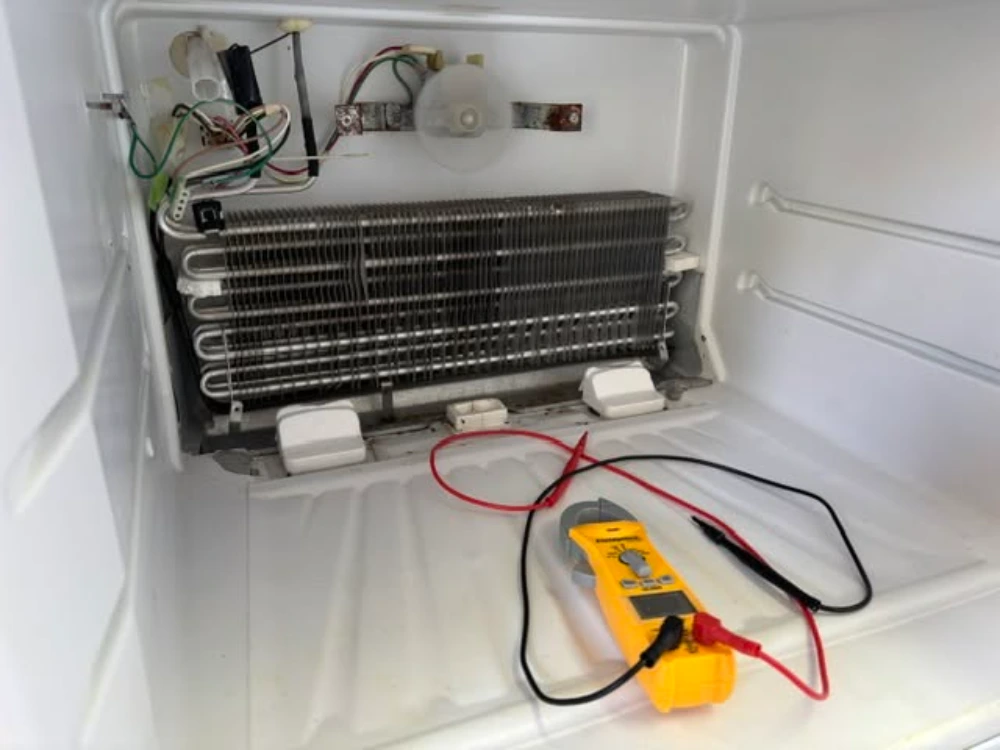
Frost builds on the evaporator and blocks airflow. The freezer may feel fine while the fridge warms up.
Condenser fan
A failed fan on the compressor side lets heat build up.
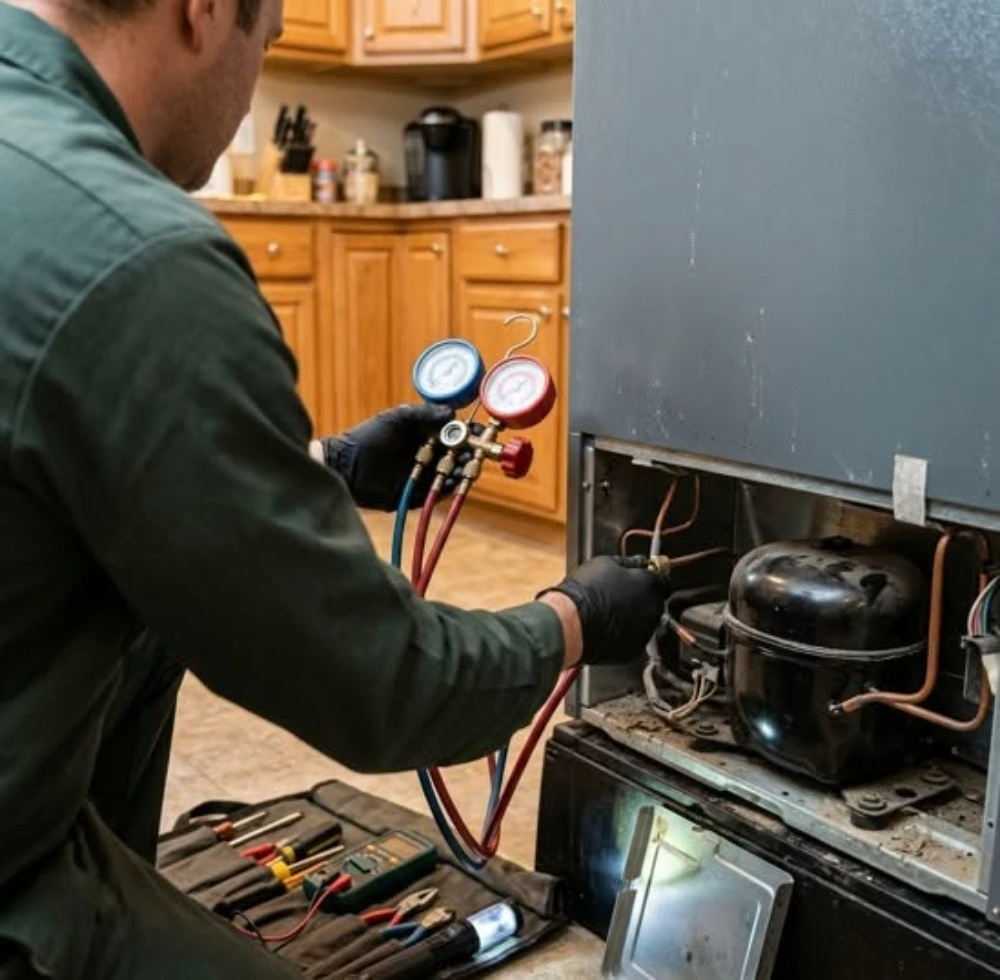
Start relay or compressor
A clicking sound followed by silence may mean the start components or the compressor have failed.
Door seal or door left open
A worn gasket or a door that does not close lets warm air in.
The freezer is cold but the fridge is warm
This is a classic sign of an airflow problem. Most frost-free refrigerators make cold air in the freezer and send some of it into the fridge through a vent. If the evaporator fan fails or frost blocks the airflow, the freezer stays cold while the fridge warms up. A damper that does not open can cause the same problem.
A quick test is to look at the back wall of the freezer. A thick layer of frost points to the defrost system. We can find which part failed and explain what the repair involves. See refrigerator repair.
Both sections are warm
If both the fridge and freezer are warm, think power, the compressor, the start components, the condenser fan or a sealed system problem. A clicking sound every few minutes can mean the start relay is trying and failing. Dirty coils can also cause this if they are bad enough.
Unplug the fridge for a couple of minutes and plug it back in. If the compressor starts and the fridge slowly cools, a control or relay problem is possible. If nothing happens, call us.
Clean the coils safely
- Unplug the refrigerator first
- Find the coils behind the lower front grille or on the back
- Use a coil brush and a vacuum to remove dust and pet hair
- Clean the area around the fan, too
- Plug the fridge back in and give it 24 hours to recover
Cleaning the coils is one of the most useful things you can do and often helps with a fridge that cools slowly or runs all the time.
Refrigerators in Laramie homes
Many Laramie homes have a second fridge in the garage or basement, and a refrigerator in an unheated space can behave oddly in winter. When the room is colder than the fridge section needs, the fridge can stop running and the fridge compartment may drift warm while the freezer stays cold, or the reverse. If your garage fridge seems off in cold weather, the room temperature may be the reason. Dry air and dust can also clog coils faster, and the high elevation does not change how a fridge works but heavy use and tight spaces do. Student houses and rentals often have older refrigerators, so ask your landlord and call us with the details.
Reading the sounds your fridge makes
The noises a refrigerator makes tell you a lot, and describing them well helps us come prepared.
- A steady hum with a warm fridge often points to dirty coils, a fan problem or a defrost fault
- Clicking every few minutes, with no hum, can mean a failing start relay
- A loud buzz or rattle may be a fan hitting ice or a loose part
- Total silence usually means no power, a control fault or a failed compressor
- A gurgle after the cycle ends is normal refrigerant flow
- Dripping or a sizzle is often defrost water hitting the heater
If you can, record a short video with your phone. It is surprisingly useful.
When to stop and call
- The fridge is warm after you cleaned the coils and checked the settings
- You hear clicking and no hum from the compressor
- There is a burning smell or visible water around electrical parts
- The temperature keeps climbing even after a power reset
- You have food to protect and the fridge has not recovered in a few hours
Quick myths worth skipping
Turning the dial to the coldest setting rarely helps a fridge that is not cooling; it can make a frozen evaporator worse. Leaving the door open while cleaning lets the temperature climb. And adding ice packs does not fix the cause. Check the basics, protect your food and call if the problem remains.
What we will ask when you call
To save time, we will ask for the brand and model number, whether the fridge is frost free, which compartments are warm, how long it has been warm, any sounds, and whether the coils have been cleaned. If you have a thermometer reading, share it. If the fridge is in a rental, tell us who can approve the repair. These answers usually let us narrow down the likely cause before we arrive, which makes the visit faster and more useful for you.
Is it worth repairing?
Fans, relays, sensors, gaskets and defrost parts are often worth fixing on a fridge in good shape. A sealed system problem on an older fridge is a harder call. We weigh the age, the fault and parts, then tell you what we would do. See repair or replace.
Keep it from happening again
Clean the coils
Twice a year, or more with pets.
Do not overfill
Air must move around food.
Do not block vents
Keep food away from the air vents.
Check the seals
A tight gasket keeps cold in.
Keep a thermometer
A simple appliance thermometer shows real temperature.
Leave space
Allow air around the back and sides.
Related help
Refrigerator repair
Our full refrigerator repair service.
Fridge stopped working
Urgent steps for the first hours.
Freezer repair
If the freezer is the problem.
Winter appliance care
Cold-weather tips for Laramie.
Before you call
What to have ready.
All repair guides
Browse by symptom.
Frequently asked questions
Straight answers to what people ask us most.
Why is my refrigerator not cooling but the light is on?
The light only means there is power. Dirty coils, a failed fan, a defrost problem, or a start relay or compressor fault can all stop cooling.
Why is my freezer cold but my fridge warm?
Usually an airflow problem such as a failed evaporator fan, a frost-blocked evaporator or a stuck damper.
How long is food safe in a warm fridge?
Perishable food above 40°F for more than two hours should be thrown out, according to USDA guidance.
How long does a fridge stay cold without power?
About 4 hours if the doors stay closed.
Can dirty coils stop a fridge from cooling?
Yes. They are a very common cause of poor cooling and constant running.
Why does my fridge click but not start?
The start relay or the compressor may be failing. Call us.
What temperature should my fridge be?
40°F or below. Around 37°F is a good target. The freezer should be at 0°F.
Why does my garage fridge struggle in winter?
A very cold room can confuse the temperature control and cause uneven cooling.
Is it worth repairing an old fridge?
Often yes for common parts. We will tell you honestly when replacing makes more sense.
What should I do while I wait for service?
Keep the doors shut, move perishables to a cooler with ice and use a thermometer to check food.
Ready to get your appliance working again?
Call or text with the appliance, the brand and what it is doing, or send a request and we will get back to you.